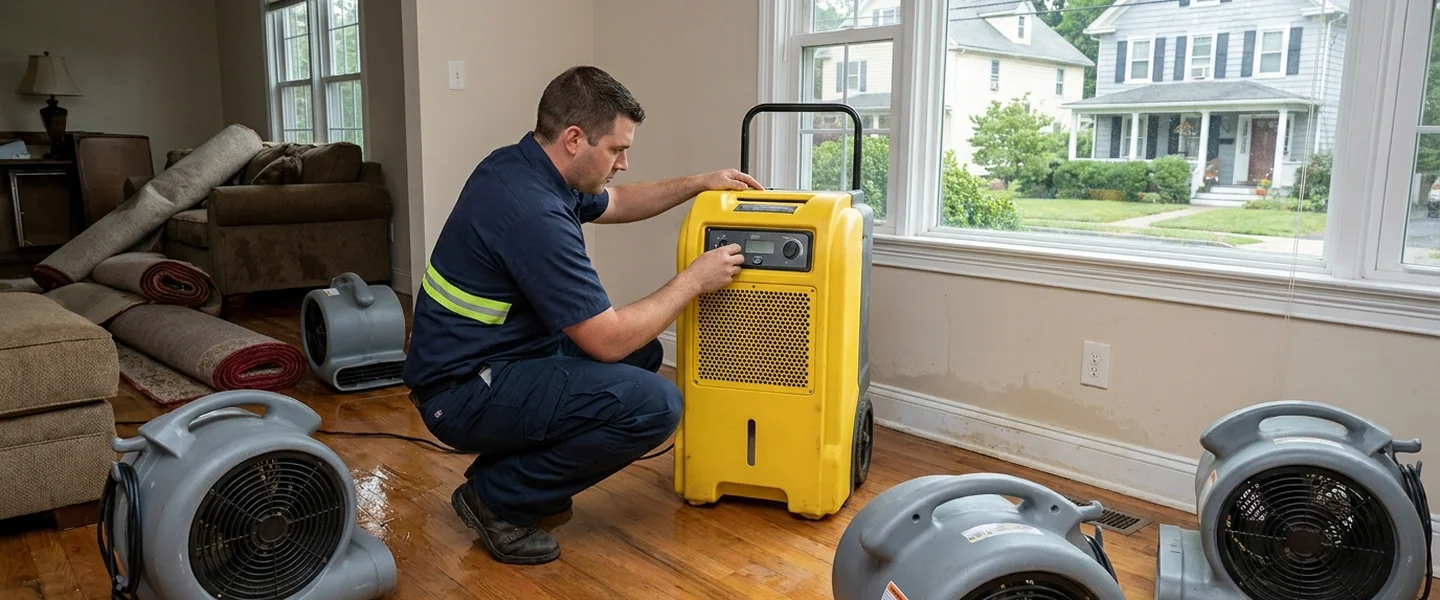
How Long Does Structural Drying Actually Take?
24/7 emergency response across the Morristown metro from IICRC-certified water restoration specialists.
- IICRC-Certified (WRT, ASD, AMRT)
- 24/7 Emergency Response
- Direct Insurance Billing
- Locally Owned, Morristown-Based
- Free On-Site Damage Assessment
The most common question we get during an active dry-out in a Morristown home is “how long is this going to take?” Homeowners want to plan around the equipment noise, the kids and pets, the work schedule, the temporary alternate housing (if it comes to that). The honest answer is that structural drying timelines depend on five or six specific variables, but for the typical Morristown-area Cat 1 water loss, the dry-out runs 3-5 days from extraction to final sign-off. This post breaks down what affects the timeline and why some losses take longer than others.
What “Structural Drying” Actually Means
Structural drying is the active dry-out phase that follows bulk water extraction. The IICRC S500 standard for water damage restoration defines a “dry standard” — a moisture content target for each affected material — that the drying process must reach before the work is considered complete. Wood is typically dry at 15% moisture content or less. Drywall is typically dry at 1% MC by capacitance meter. Concrete is typically dry at 4% MC by capacitance. Until every mapped point hits the published standard, the dry-out continues.
The Standard Cat 1 Dry-Out: 3-5 Days
For a typical Morristown-area Cat 1 water loss — a burst supply line, a water heater failure, a slab leak with limited demo — the dry-out runs 3-5 days. Day 1 is the high-equipment-count day: maximum number of air movers, maximum dehumidifier capacity, all targeting the worst moisture readings. Days 2-3 are the steady-state drying phase, with daily moisture readings and adjustments to equipment placement. Day 4-5 is the final-readings phase, where most points have already hit dry standard and we’re verifying the last few. By day 5 the home is at standard, equipment leaves, and the documentation packet goes to your insurance file.
The Cat 2 Dry-Out: 5-7 Days
Cat 2 (gray water — dishwasher discharge, washing machine, some toilet overflows) adds antimicrobial dwell time and slightly broader demo scope. The dry-out itself runs the same 3-5 days but the front end includes containment setup and antimicrobial application, and the back end may include verification. Total project: 5-7 days.
The Cat 3 Dry-Out: 7-14 Days
Cat 3 (sewage, ground-water intrusion, multi-day standing water) requires full hazmat containment, broader demo (entire drywall panels rather than just 2 feet up), documented disinfection with EPA-registered antimicrobials at full dwell times, post-remediation verification, and the structural drying. The combined timeline is 7-14 days depending on the affected square footage and the demo scope.
The Mold Remediation Project: 5-10 Days
If mold has already established (typically because the water sat 48+ hours before extraction began), remediation under IICRC S520 is added to the project. Containment setup, removal of contaminated porous materials, antimicrobial treatment, HEPA vacuuming, moisture-source elimination, and post-remediation verification. Combined with structural drying, the project runs 5-10 days.
What Adds Days to the Timeline
Wet hardwood floors. Hardwood is the slowest-drying material in a typical residential build. Even with mat-drying systems (vacuum-extraction mats placed directly on the floor) hardwood often takes 7-10 days to hit dry standard, and sometimes the wood is too cupped to save and replacement is the only path.
Saturated subfloor below tile. Tile floors don’t soak water; the subfloor below them does. Drying through tile requires either removal or specialized injection-drying systems. Adds 2-4 days to a typical timeline.
Wet insulation in wall cavities. Open-cell spray foam insulation that has wicked moisture stays wet for a long time. Sometimes the only path is removal and replacement.
Concrete slabs that absorbed water. Concrete dries very slowly. A slab-on-grade home with water that wicked into the slab needs extended dehumidification — sometimes 7-10 days alone for the slab to hit dry standard.
Wet engineered wood / laminate flooring. Most laminate flooring is not salvageable after a water event — it swells, delaminates, and locks the moisture into the subfloor below. Removal extends the demo scope and the dry-out.
Insurance approval delays. If the adjuster takes time to approve the scope, work can pause mid-project. This is more common during regional event surges in the Morristown metro — spring snowmelt and summer thunderstorms, February freezes.
Reconstruction starting before dry-out complete. Some homeowners want the GC working in parallel with the dry-out. We don’t recommend this — drywall installed before the framing is dry traps residual moisture and produces mold within months.
What Doesn’t Add Days
Square footage alone doesn’t add days in proportion to the size of the loss. A 200 sq ft kitchen flood and a 2,000 sq ft whole-house flood both run on the same 3-5 day timeline if the materials and water category are similar — the larger loss just uses more equipment and more crew hours per day. We adjust crew and equipment counts to keep the timeline predictable.
What to Plan Around the Dry-Out
You can usually live in the home throughout a Cat 1 dry-out. Equipment runs continuously and is loud — air movers produce 70-80 dB, similar to a vacuum cleaner — but most homeowners adapt. Pets and kids should be kept away from the equipment and the affected rooms. Cat 2 and Cat 3 dry-outs usually require evacuation of the affected area until disinfection completes; most homeowners policies cover alternate housing under ALE (additional living expense).
Temperature: the dry-out typically pulls 5-10°F of heat out of the affected area as the dehumidifiers run. We sometimes use supplemental heat in winter to keep the materials at the optimal drying temperature (around 70-80°F is ideal for drying wood). Power: dehumidifiers and air movers add significant electrical load to the home. We work with the existing service capacity and add temporary distribution where needed.
Why Some Companies Quote Shorter Timelines
National franchises sometimes quote 1-2 day dry-out timelines for Morristown-area Cat 1 losses. The shorter timeline almost always means they’re not actually drying to the IICRC S500 dry standard — they’re pulling equipment when the surface looks dry, leaving residual moisture in framing and subfloor that produces mold within 60-90 days. Reputable Morristown-area contractors dry to standard, not to the calendar.
Daily Moisture Log: How We Document the Timeline
Every day a technician visits the loss, takes moisture readings at every mapped point, logs them with timestamps and photos, and adjusts equipment placement based on the data. The daily log is the documentation that proves dry standard was achieved — both for our records and for your insurance file. Adjusters routinely request the moisture log when claims are reviewed, and a clean log dramatically shortens approval cycles.
Common Misconceptions About Drying Timeline
“Drying should take 24 hours.”
Almost never. Surface dryness happens in 24 hours; structural dryness takes days. A 24-hour dry-out is a marketing claim, not an IICRC-standard one.
“The carrier won’t pay for more than 3 days.”
Wrong. The carrier pays for the time needed to hit dry standard, documented by the moisture log. Carriers routinely approve 7-10 day dry-outs when the documentation supports it.
“I’ll save time by drying the home myself with fans.”
Household fans move air but don’t remove moisture. Without commercial dehumidification you’re just moving humid air around — not drying. The DIY approach almost always leaves residual moisture that produces mold.
“The longer the dry-out, the worse the damage.”
Not necessarily. Some materials (hardwood, concrete slab, saturated insulation) take a long time to dry even with optimal equipment. The duration reflects the materials, not the quality of the work.
Questions to Ask the Contractor About Timeline
- Will you dry to the IICRC S500 dry standard, and how is that verified?
- What’s the day-by-day breakdown of the dry-out?
- Will the same technician monitor the dry-out daily?
- Will the moisture log be in the file you send my adjuster?
- What would extend the timeline, and how do you communicate that?
- When can we expect equipment to come out and the home to be ready for reconstruction?
Bottom Line
For a typical Morristown-area Cat 1 water loss, plan on 3-5 days of structural drying. Cat 2 and Cat 3 losses run 5-14 days depending on scope. We give you a daily plan within the first 24 hours and we communicate any timeline changes as they happen. Call (862) 305-9815 for 24/7 emergency response and a documented dry-out to IICRC S500 standard.
Morristown-Area Service Areas
We respond 24/7 across Morristown and the surrounding Morris County suburbs. Click your area for local details and the housing-stock patterns we typically encounter:
Flooded? Call Now — 24/7 Emergency Response in Morristown
Truck-mounted extractors dispatched within the hour. Direct insurance billing. Serving Morristown and surrounding areas including Madison, Chatham, Morris Plains, Florham Park, Convent Station, Mendham, Whippany, Parsippany.