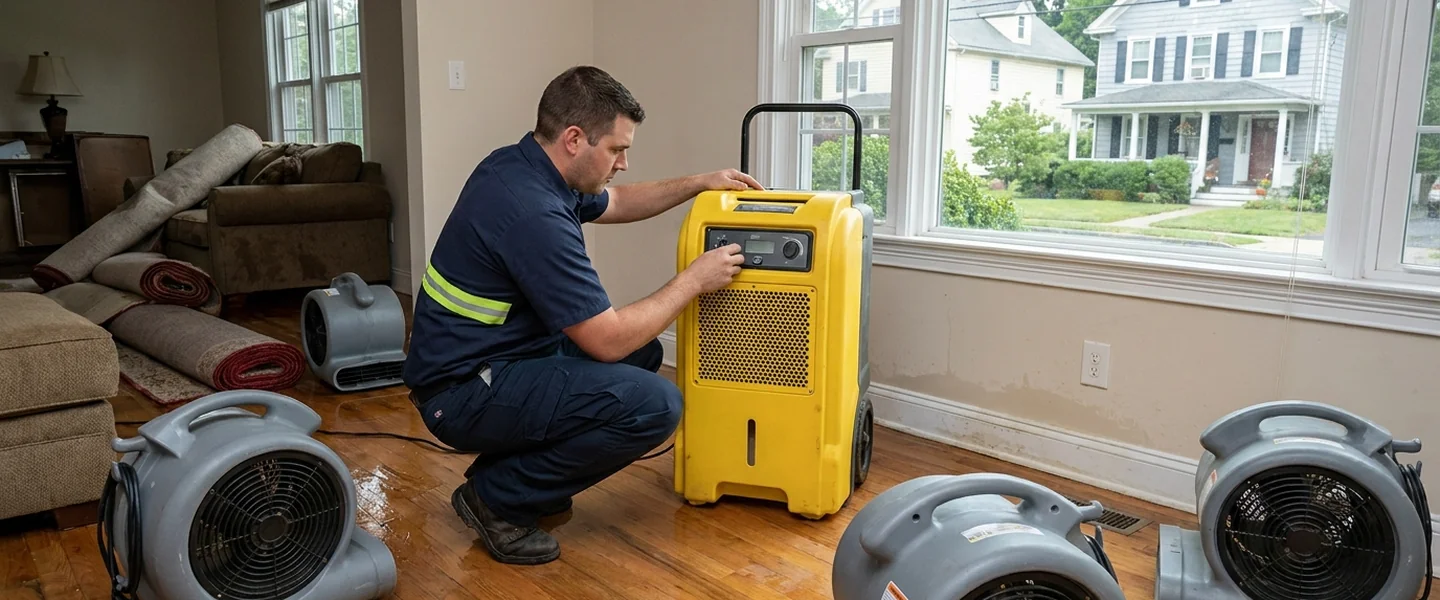
Morristown Storm Damage: When to Call a Restoration Company vs Your Insurance First
24/7 emergency response across the Morristown metro from IICRC-certified water restoration specialists.
- IICRC-Certified (WRT, ASD, AMRT)
- 24/7 Emergency Response
- Direct Insurance Billing
- Locally Owned, Morristown-Based
- Free On-Site Damage Assessment
Storm damage in Morristown produces a specific homeowner decision: do I call my insurance company first, or do I call a restoration company first? The answer matters because the order changes how the claim documents, how the response unfolds, and how much out-of-pocket the homeowner faces. We see this decision made dozens of times per year in Madison, Chatham, Florham Park, and across the Morristown area after spring snowmelt events, summer thunderstorm cells, and hurricane-remnant rain events. This post explains when to call which, and why.
The Short Answer
For active water damage where the home is actively taking on water (a breached roof during a storm, a window failure with wind-driven rain entering, a flooded room): call the restoration company first. Stop the active damage, then call the carrier with documentation. For storm damage that has already stopped (a hail-damaged roof you discovered the morning after, a tree fall on the exterior with no water entry): call the carrier first. The adjuster will document the damage and authorize scope before work begins.
Why the Restoration Company First Makes Sense for Active Damage
Every New Jersey homeowners policy has language about “reasonable mitigation efforts” — the policyholder is expected to take reasonable steps to prevent further damage from a covered loss. When water is actively damaging the home, the most reasonable mitigation is to extract the water and stop the spread. Calling the carrier first and waiting for an adjuster (24-48 hours) means thousands of additional dollars of damage that you may end up paying for under “failure to mitigate.” Calling the restoration company first stops the damage and produces documented mitigation that the carrier rewards.
Once the restoration crew is on site, they typically handle the carrier notification themselves — we have a documented intake process that includes calling the carrier with the homeowner’s authorization and getting the claim number. The carrier appreciates organized notification more than rushed first-call hysteria.
Why the Carrier First Makes Sense for Stopped Damage
If the damage has already stopped — a hailstorm hit your roof during the night and you discovered shingle damage in the morning, a tree fell on the side of the home and there is no active water entry — there is no active damage to stop. Calling the carrier first gives the adjuster time to assess the damage in its as-found condition. The adjuster may approve scope (roof repair, tree removal, exterior siding) before any work begins. Restoration scope at that point is reactive, not preventive.
The Morristown Storm Pattern
Summer thunderstorm rainfall in the Morristown area produces a specific pattern. The storm cell moves through a defined corridor — sometimes a few miles wide — and dumps 1-3 inches of rain per hour with associated straight-line winds. Subdivisions in the corridor see roof leaks at compromised flashings, combined sewer backups in older neighborhoods, sump pump overwhelm in finished basements, and stone-foundation seepage in pre-war homes. Hurricane and tropical-remnant events have broader reach — multi-day rain plus power outages that take sump pumps offline across the entire Morris County area. Spring snowmelt events affect the lower-lying neighborhoods near the Whippany River, Lake Hiawatha, and the Passaic River corridor most acutely.
What “Active Water Damage” Looks Like
If any of these apply, call the restoration company first: water actively entering the home (roof breach, window leak, slab-perimeter intrusion); standing water on the floor; water saturating drywall, carpet, hardwood, or cabinetry; water entering a basement or low-floor area; ceiling drip from above; HVAC condensate flood; supply-line failure. Any of these means active damage that compounds with time.
What “Stopped Damage” Looks Like
If the damage has settled into a static state, call the carrier first: hail damage to roof shingles or exterior siding (visible the morning after); wind damage to a tree that’s down but not actively damaging the structure; broken windows from hail with no continuing rain entry; a small leak from a previous storm that has dried but left staining (this becomes a question of whether the original loss was reported promptly).
How the Two Calls Interact
When the restoration company arrives first for active damage, we work in parallel with the carrier notification. Our standard intake includes: confirming you’ve called the carrier (or calling on your behalf with your authorization), obtaining the claim number, identifying the adjuster contact, and routing our Xactimate-format estimate directly to that adjuster. The carrier sees a documented mitigation effort, an IICRC-certified contractor on site, and clean line-item pricing — all of which produce faster claim approval than a homeowner who waited 24 hours for the adjuster while damage compounded.
When You Should Call Both Simultaneously
For large-scope storm damage events — a regional event affecting many homes — you may want to call both immediately. The carrier’s adjuster queue can be backed up during major events (we routinely see 5-7 day adjuster response delays during peak regional events), and the restoration company can begin documented mitigation while the adjuster works through the queue. Both calls are warranted.
Documentation Matters Either Way
Regardless of which call comes first, document immediately. Photograph the damage thoroughly before any cleanup. Take wide shots of every affected room, close-ups of the source, ceiling damage, wall damage, floor damage. Take videos walking through the space narrating what you see. The carrier values this documentation more than anything else in the file. If you can’t access the damage safely (active flooding, active electrical risk), wait until the restoration crew arrives and document with their assistance.
The Storm-Chaser Problem
After a major Morristown-area storm event, door-to-door solicitors descend on affected neighborhoods. Roofers offering “free inspections,” general contractors offering “we work with all insurance,” restoration companies that aren’t IICRC-certified and have no local presence. These are storm chasers, often from out of state, and they consistently produce contested claims and incomplete work. Reputable Morristown-area restoration companies do not door-knock after a storm. They take calls from homeowners who heard their name from a neighbor, a Google search, or a carrier referral. If someone knocks on your door after a storm, decline politely and call a contractor with local references.
Insurance Endorsement Considerations
New Jersey homeowners policies have a few endorsements that matter for storm damage. The water/sewer backup endorsement (typically a few dollars per month) covers sewer-main backups, which standard policies exclude. Flood coverage from NFIP is separate and required for ground-water intrusion. Most of Morristown is outside FEMA SFHA zones, but if your home is near a creek, retention pond, or low-grade area, NFIP coverage is worth considering. ALE (additional living expense) coverage pays for alternate housing if the home is uninhabitable; most policies include this but the daily cap and total cap vary.
Common Misconceptions About Storm Damage Calls
“I should call the carrier first no matter what.”
For active water damage, no. The mitigation clock matters. Restoration company first, carrier within the first hour.
“My carrier will tell me which contractor to use.”
Carriers maintain preferred-provider networks but in New Jersey you have the right to choose your contractor. The preferred network is a recommendation, not a requirement.
“The first contractor to arrive should get the job.”
Not necessarily. The contractor’s credentials, references, local presence, and documentation matter more than arrival order. A storm chaser who shows up door-knocking 4 hours after the storm is not the right contractor.
“Filing a claim will raise my rates dramatically.”
A single storm claim in a 5-year window typically doesn’t move the rate dramatically. Multiple claims do. Storm damage in particular is treated more leniently by New Jersey carriers because it’s clearly external causation.
Morristown-Specific Considerations
Spring snowmelt and thunderstorm season (March-August) is the peak claim window. Frozen-pipe burst season (December-February) is the secondary peak. Major hail events can produce five- and six-figure losses to a single home (roof, siding, gutters, windows). The most common storm-damage call sequence in the Morristown metro is: restoration company arrives for active water entry, carrier notification within the first hour, adjuster on site within 24-48 hours, restoration scope approved within a week, roofing scope approved separately, reconstruction over the following weeks. Total project: 4-8 weeks for a moderate-scope storm loss.
What to Do During the Storm
If the storm is still active and water is entering: shut off power to wet areas, move valuables to dry areas, place buckets or tarps to contain continuing drip, photograph as you go, and wait for the storm to pass before exiting. Once safe to do so, call restoration. If a tree is on the structure, do not approach — wait for professional removal.
Bottom Line
For active water damage from Morristown-area storms, call the restoration company first. For stopped damage (hail, wind without water entry, fallen trees), call the carrier first. For major regional events, call both. We answer 24/7 at (862) 305-9815 with IICRC-certified crews on standby across the metro during peak storm seasons.
Morristown-Area Service Areas
We respond 24/7 across Morristown and the surrounding Morris County suburbs. Click your area for local details and the housing-stock patterns we typically encounter:
Flooded? Call Now — 24/7 Emergency Response in Morristown
Truck-mounted extractors dispatched within the hour. Direct insurance billing. Serving Morristown and surrounding areas including Madison, Chatham, Morris Plains, Florham Park, Convent Station, Mendham, Whippany, Parsippany.